
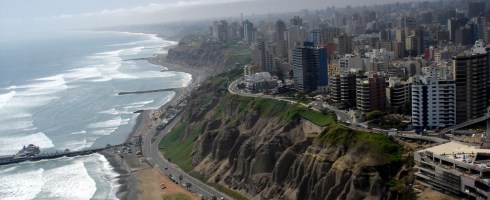
It gripped us around the throat and slapped us hard in the face. Our first impression of Lima, Peru’s massive capital city, were not favourable. Our bus crawled painfully bumper-to-bumper through lanes of traffic jams for nearly 1.5 hours to reach the central bus terminal. Black smoke belched out from the cars and buses around us and an endless cacophony of car horns told of people’s daily frustrations. With large proportions of the city’s 8 million inhabitants crammed into shanty towns and dilapidated buildings on the outskirts of the city, the grey, unattractive urban mass sprawled in every direction. The blue skies we’d had elsewhere in Peru, had been replaced with a blanket of clouds and a chilly drizzle swept across the city from the coastline on which it sits. We noticed homeless people sleeping on the streets and shady characters hanging around on corners and, without thinking, we’d picked up our bags from the floor and were holding them tightly on our laps. If it’s true that first impressions count and you can make your mind up about someone or somewhere within the first 10 seconds, Lima would need to go on a charm offensive to win us round.
Riding a sand tsunami in Huacachina
10 Nov
We collapsed into a heap after climbing to the top of a 60 metre sand dune and paused to catch our breath. We stared in awe at the scene before us – immense, golden dunes and nestled in the middle a picturesque lagoon-filled oasis surrounded by palm trees. Huacachina was once a prestigious holiday destination for Peru’s rich elite, however, nowadays it’s a regular stop on the Gringo trail and an adventure theme park for international backpackers.
The mysterious Nazca Lines
1 Nov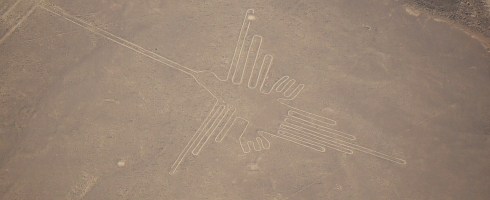
The mysterious Nazca Lines are spread over 500 square kilometres in a dusty, desert landscape in the South of Peru. The lines were first discovered in 1927 when a Peruvian archeologist, Toribio Mejia Xesspe, spotted them whilst walking in the nearby foothills, however, they were largely ignored by the outside world. In 1939, a historian from Long Island University in the United States took a flight over the area and upon seeing these giant lines and figures etched into the ground, he made it his duty to inform the world about them. Every year since, more formations have been discovered and there is presently a striking network of over 80 lines, 300 geometric figures and around 70 animals. In 1994 the site was honoured with UNESCO World Heritage status.
Kingdom of the Ice Princess
26 Oct
Surrounded by stunning volcanos and the world’s deepest canyons, Peru’s second biggest city, Arequipa, rises like a mirage out of the high altitude desert. The landscape surrounding Arequipa is untamed and at times looks like the surface of the moon but in contrast, this university city is sophisticated, cultured and awash with life.
Lost City of the Incas – Machu Picchu
23 Oct
Our blaring alarm jolted us from deep sleep at 4.00am like a bad nightmare. We tiredly pulled on several layers of clothes, grabbed our pre-packed day bag and left our hotel at 4.30am in the pitch black. We carried torches as just outside of town there were no street lights. It took around 30 minutes to reach the start of a strenuous one hour up-hill climb which leads to the entry point of Machu Picchu. In the dark we were joined by dozens of other people also making the climb in order to be allowed first entrance at 6.00am and have the chance to see a spectacular sunrise over the site.
Pilgrimage to Machu Picchu – The Salkantay trek
21 Oct
Machu Picchu is considered to be one of the new 10 Wonders of the World and the legendary Inca Trail, a 4 day and 3 night trek following the old Inca road, is the most popular way to reach the site, taking in several smaller archeological sites along the way and reaching Machu Picchu for sunrise on day 4. Over the last 10 years or so the Inca Trail seems to have become a victim of its own success. Several years ago it became necessary to limit the number of trekkers using the trail as the sheer volume of traffic meant that the ruins were being damaged, litter was becoming a problem and sanitary conditions were appalling. The quota is now 500 people per day, which, along with trekkers, includes guides, porters and cooks. The measures taken were required to preserve Machu Picchu, but the outcome has been devastating for the humble backpacker with prices for the trek going through the roof and the waiting list to join the trek extending to 5 or 6 months in some cases. With all of this considered, we decided to try one of the many alternative treks, which offer equally as stunning scenery and the chance to visit small villages before ending up at Machu Picchu on the ultimate day. The alternative trek we chose was the Salkantay trek which traverses snow-capped mountain ranges, passes turquoise lagoons and hot springs, and descends into lush jungle before spending one night at a small town called Aguas Calientes and rising early the following morning for sunrise at Machu Picchu.
Cusco – City of Kings
17 Oct
If a current day Inca King had the choice of where to build his palace and base his army, there’s no doubt that Cusco would be it. This city in the clouds attracts hundreds of thousands of international visitors every year who are drawn here by colonial majesty built amidst the cobbled alleyways and mighty stone walls of the Incas. Often described as the ‘archaeological capital of the Americas’, Cusco is bursting with historic sites and is the gateway to the beautiful Sacred Valley where Inca fortresses are perched on hill tops and indigenous locals farm and sell their goods at colourful markets as they have done for hundreds of years. Peru’s poster boy is the world-famous Machu Picchu, lost city of the Incas, and Cusco is also the starting point for an unforgettable trip to this new wonder of the modern world.
Magical Lake Titicaca
11 Oct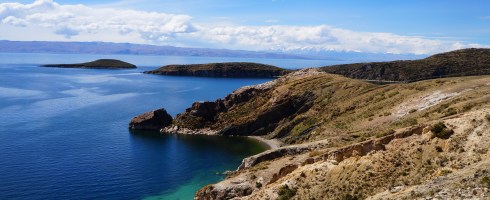
The Incas believed that Lake Titicaca was the place the world began, when the god Viracocha came out of the lake and created the sun, the stars and the first people. For us, the lake certainly did have a mythological magic about it, and a striking beauty with its glistening cobalt blue waters and surrounding sun-drenched, fertile valleys.
Welcome

Featured posts
-

Torres del Paine – the ‘W’ trek
Visitors from all walks of life converge on the small hamlet of Puerto Natales to visit Chile’s and perhaps the Continent’s number one national park – Torres del Paine. Located in the Southern Patagonian ice fields at the end of the Andes, the park offers diverse wildlife and incredible mountain scenery, glaciers, lakes, rivers and […]
 latin chattin'